TRUSTED PARTNERS





Classroom PALS vs. online PALS certification
When it comes to earning your pediatric advanced life support certification, you have two primary options, traditional classroom training or online certification. The methods cover key topics and knowledge required to respond to pediatric emergencies. Here is a tabular representation of the differences between classroom PALS and PALS certification online.
PALS certification advantages
PALS certification advantages
Becoming PALS certified offers several benefits for healthcare professionals, including:
- Enhanced pediatric emergency skills: Equips you with the knowledge and skills to handle pediatric emergencies and improve patient outcomes.
- Increased job opportunities: Opens up new opportunities of employment in pediatric care and emergency departments.
- Boosts confidence during emergencies: Helps you gain confidence in recognizing and responding quickly to life-threatening pediatric conditions.
- Better teamwork and communication: Teaches effective teamwork skills to perform during resuscitation, further enhancing collaboration.
- Complies with healthcare standards: Ensures you meet industry standards for pediatric care and keeps you compliant with healthcare regulations.
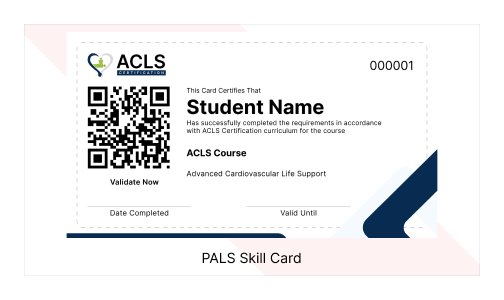
What do you get when you certify with us?
What do you get when you certify with us?
When you certify with us, you gain the following benefits:
- 24/7 access to study materials: Get round-the-clock access to study materials covering key topics such as respiratory distress.
- Earn 4-8 CE credits: Fulfill your continuing education requirements and advance in your pediatric emergency skills.
- Unlimited exam attempts: Take the exam as many times as required to pass the quiz without feeling added pressure.
- Flexible learning: Learn from experienced professionals at your own pace, perfectly fitting your busy schedule.
- Free BLS course included: Get an additional basic life support (BLS) certification at no additional cost.
How Do You Choose an Online PALS Provider?
Accreditation
Ensure that the provider is nationally recognized & offers a valid certificate.
Course format
Choose a course that is flexible and offers self-paced learning.
Certification validity
Choose a provider whose instructors are PALS certified & offer customer support.
Cost and convenience
Compare prices and select a provider that fits your budget and schedule.
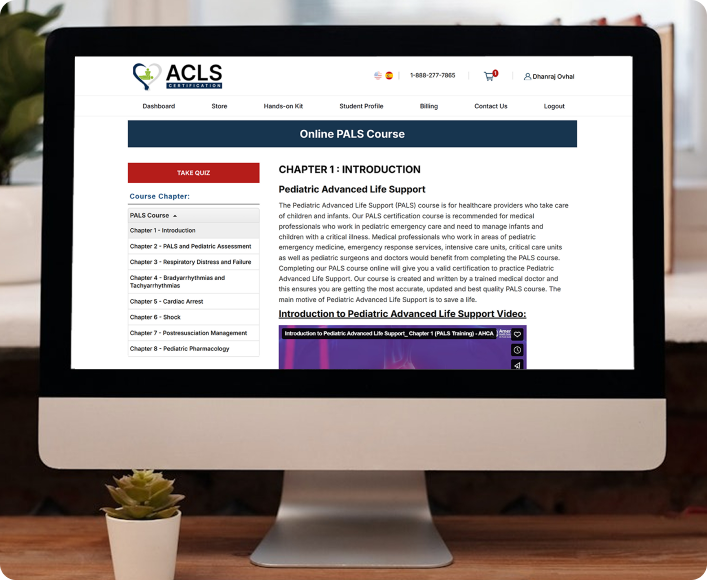
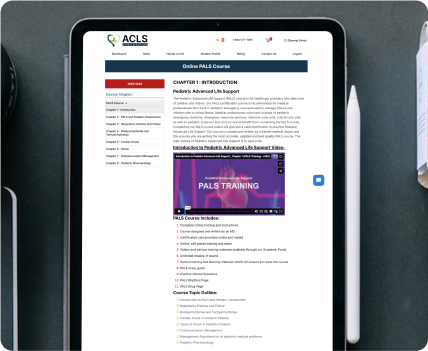
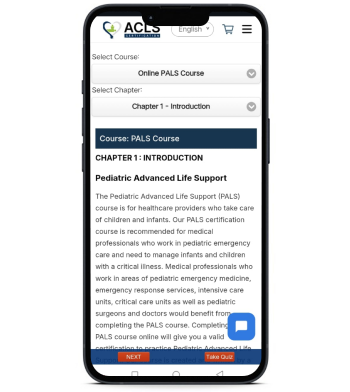
PALS Course Curriculum
- Introduction
- PALS and Pediatric Assessment
- Respiratory Distress and Failure
- Bradyarrhythmias and Tachyarrhythmias
- Cardiac Arrest
- Shock
- Postresuscitation Management
- Pediatric Pharmacology
PALS resource links
How do I become PALS certified?
Here are steps to become PALS certified:
- Enroll for our PALS course: Choose our nationally accepted course specializing in pediatric care.
- Complete the course: Study online modules that cover pediatric emergency assessment, stabilization, and resuscitation.
- Pass the examination: Take the online quiz and pass your examination. You can also take our practice tests to feel more confident.
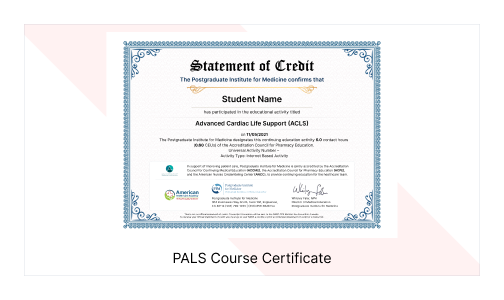
- Receive your PALS certification: Once you complete the course, you will receive your PALS certification card, valid for two years.
What PALS Certification Covers
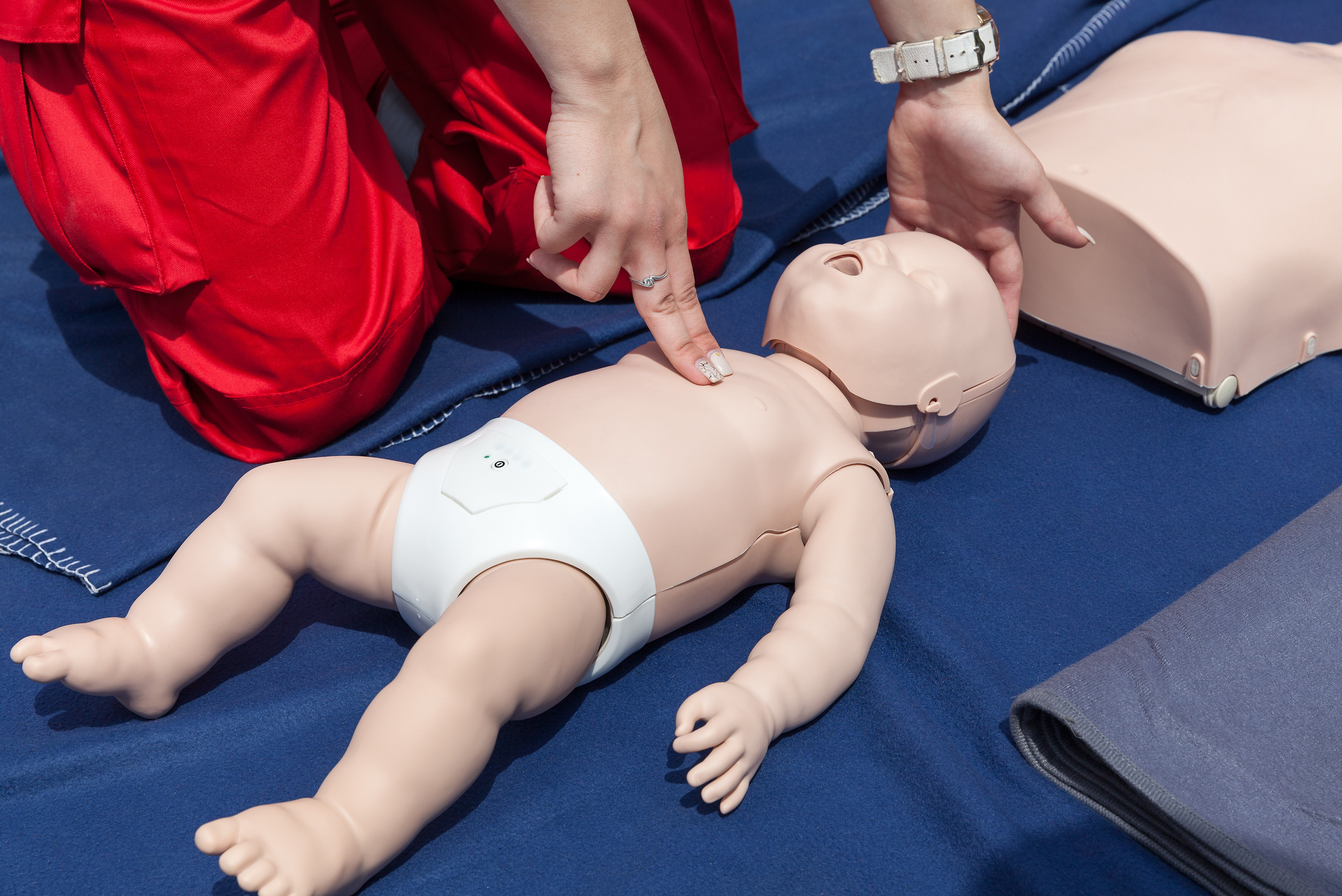
Pediatric Advanced Life Support certification prepares healthcare providers to recognize and manage life-threatening emergencies in infants and children. The course covers pediatric assessment, respiratory distress and failure, shock, cardiac arrest, and post-resuscitation management, along with pediatric-specific pharmacology dosing that differs meaningfully from adult protocols. Learners study bradyarrhythmia and tachyarrhythmia recognition in young patients, since pediatric rhythm disturbances often present differently than in adults.
Each chapter builds toward a final certification exam that verifies your ability to apply PALS algorithms accurately under time pressure. Upon passing, you receive a wallet card and certificate valid for two years, and a free Basic Life Support course is included with every PALS enrollment at no added cost.
Who Should Take This PALS Course
PALS certification is required for healthcare providers who care for infants and children in emergency or critical care settings. Pediatric nurses, emergency department staff, paramedics, respiratory therapists, and physicians working in pediatric ICUs or neonatal units typically must hold current PALS credentials as a condition of employment.
School nurses, urgent care staff, and providers in mixed adult-pediatric emergency departments also pursue PALS to be prepared for pediatric codes even if children are not their primary patient population. If your role involves assessing or resuscitating pediatric patients, or if your facility’s credentialing policy lists PALS as a requirement for your unit, this course satisfies that training standard.
How PALS Certification Works Online
Enrollment gives you instant access to every chapter of pediatric-specific coursework, which you complete on your own schedule while covering pediatric assessment, shock, and cardiac arrest management. The certification exam is untimed, open-book, and allows unlimited attempts, so it reflects how you would reference protocols on the job rather than testing recall under artificial time pressure.
Once you pass, your digital wallet card and certificate are available immediately, with mail and print delivery options for a physical copy. Your certification is valid for two years; track that expiration date and renew through the PALS recertification course before it lapses.
AHA/ECC Alignment and Employer Acceptance
ACLSNow’s PALS course is built around the same pediatric resuscitation science reflected in the American Heart Association’s ECC guidelines, covering pediatric assessment, rhythm recognition, and resuscitation pharmacology. ACLSNow is an independent certification provider and is not the American Heart Association, and that distinction matters if your employer’s policy specifically names an AHA-branded card rather than ECC-aligned training generally.
Most hospitals, pediatric practices, and EMS agencies accept ACLSNow’s PALS certification as valid proof of competency, since the underlying training content matches current pediatric resuscitation standards. If your facility requires confirmation of accepted providers, check with your credentialing office before enrolling, since acceptance policies differ across institutions.
PALS Renewal and Recertification
Your PALS certification is valid for two years from your exam pass date. As that date approaches, you can renew through our dedicated PALS recertification course, which covers the same pediatric content in a condensed format for providers who already hold clinical experience and a recent or current card. ACLSNow does not publish a fixed grace period, so the safest approach is starting your renewal before expiration rather than after.
If you also need to renew ACLS or BLS, ACLSNow’s ACLS PALS BLS combo covers all three certifications in a single enrollment, which many pediatric and float-pool staff find more efficient than separate renewals.
Ready to
Advance Your Career?
Master Pediatric Advanced Life Support – Get Flexible Learning Opportunities and Be Prepared for Any Pediatric Emergency!

Frequently Asked Questions
Yes. Online PALS certification from an accredited, ECC-aligned provider is recognized by most hospitals, pediatric practices, and EMS agencies as valid proof of PALS competency. The course covers the same pediatric assessment, rhythm recognition, and resuscitation protocols taught in classroom settings, and the certification exam verifies the same knowledge. The main difference is delivery format, since online training lets you complete coursework on your own schedule rather than attending a fixed session. If your employer requires a specific accrediting body’s card rather than ECC-aligned training generally, confirm that detail with your credentialing office before enrolling.
PALS covers more specialized content than Basic Life Support, since pediatric dosing, rhythm recognition, and assessment differ from adult protocols, but the course is built to prepare you thoroughly before you reach the final exam. ACLSNow’s PALS certification exam allows unlimited attempts, so a single missed question does not cost you the certification, and you can review any module again before retesting. Most learners who work through the full coursework rather than skipping ahead pass on their first or second attempt. The self-paced format also means you can slow down on pediatric pharmacology sections that are typically the most challenging part of the material.
Yes, PALS certification through ACLSNow is valid for two years from the date you pass your exam. This matches the standard validity period used across ACLS, BLS, and PALS certifications industry-wide, which makes it easier for providers holding multiple credentials to track renewal dates together. As your two-year period approaches its end, you can renew through the PALS recertification course rather than repeating full initial certification. Keeping a shared renewal calendar for all your emergency care credentials helps avoid an unexpected lapse in any one of them.
Most learners complete the full PALS certification course, including all chapters and the final exam, in about five to six hours of self-paced study, though there is no fixed calendar deadline. Because the course is entirely online and self-paced, you can spread that time across several days or complete it in a single extended session, whichever fits your schedule better. Unlimited exam attempts mean you are not penalized for taking extra time to review pediatric pharmacology or rhythm recognition sections before testing. Your two-year certification period begins on the date you pass, not the date you enroll.
PALS certification covers the assessment and resuscitation of infants and children, generally from birth through early adolescence, with pediatric-specific dosing and rhythm recognition tailored to those age groups. Once a patient reaches a size and physiology closer to an adult, standard ACLS protocols typically apply instead, though exact age cutoffs can vary by facility protocol and clinical judgment rather than a single fixed number. Providers who care for both pediatric and adult patients often hold both PALS and ACLS certification to cover the full range of patients they may encounter.
PALS certification, or Pediatric Advanced Life Support certification, verifies that a healthcare provider can recognize and manage cardiac and respiratory emergencies in infants and children. The course builds on Basic Life Support skills and adds pediatric-specific assessment, rhythm recognition, resuscitation pharmacology, and shock management, since children respond differently to emergencies than adults. Certification is earned by completing the online coursework and passing a final exam, resulting in a wallet card valid for two years. Most pediatric units, emergency departments, and EMS agencies accept it as proof of PALS competency for staff caring for young patients.