TRUSTED PARTNERS





TRUSTED PARTNERS
| Chapters | CE Credits | Valdity | Price | Duration | ECC | Exam Attempts | Wallet Card |
|---|---|---|---|---|---|---|---|
| 17 | 4.0 | 2 Year | $119.00 | 3-4 Hrs | Compliant | Unlimited | Download/Mail/Print |







PALS recertification refreshes your pediatric resuscitation skills without repeating the full initial certification course. The curriculum reviews pediatric assessment, respiratory distress and failure, shock, cardiac arrest management, and updated pharmacology dosing for infants and children, along with any changes to pediatric rhythm recognition guidance since your last certification.
Because recertification assumes existing clinical background, it moves through material faster than initial PALS certification while still covering every required topic. You complete the same exam format as initial certification, with unlimited attempts, and receive an updated wallet card and certificate valid for another two years. If your ACLS or BLS credentials are also due, ACLSNow’s ACLS PALS BLS combo renews all three in one enrollment.
If you currently hold PALS certification and your two-year period is ending soon, this recertification course is the right path. Pediatric nurses, emergency department staff, paramedics, and physicians working in pediatric or neonatal units typically need current PALS credentials as a condition of continued clinical privileges. If you have never held PALS certification before, start instead with our PALS certification course, which covers the full initial curriculum.
Recertification also applies if your card recently lapsed and you need to restore active status without starting over with full initial certification. Hospital credentialing offices and EMS agencies generally treat completed recertification the same as fresh certification, provided it comes from an accredited, ECC-aligned provider.
Enrollment gives you immediate access to the refreshed recertification modules, which you complete at your own pace while reviewing pediatric algorithm and pharmacology updates since your last certification. The final exam allows unlimited attempts, so a single missed question will not cost you your renewal, and you can revisit any module before retesting.
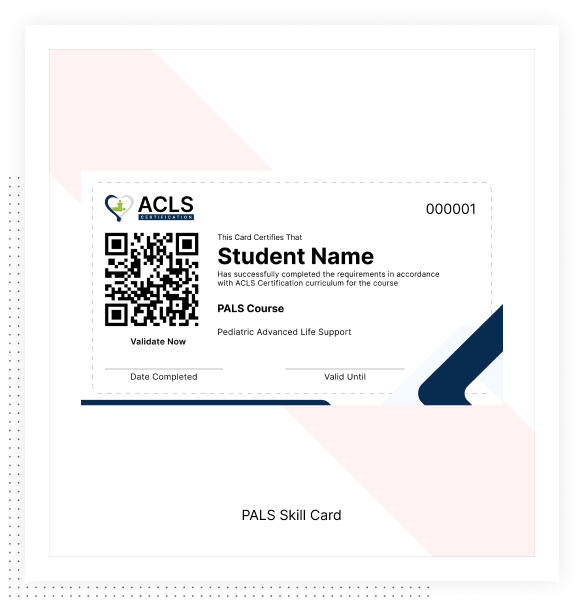
Once you pass, your updated wallet card and certificate are available for immediate download, with mail and print options available for a physical copy. Setting a reminder ahead of your new two-year expiration date helps you start your next renewal before the deadline rather than scrambling after it passes.
ACLSNow’s PALS recertification course maps to the same pediatric resuscitation science reflected in the American Heart Association’s ECC guidelines, though ACLSNow is an independent provider and not the American Heart Association itself. Most hospitals, pediatric practices, and EMS agencies accept ECC-aligned recertification from an accredited provider as sufficient proof of continued PALS competency, regardless of which organization issues the card.
If your facility specifically requires an AHA-branded renewal, confirm that policy with your credentialing office before enrolling, since acceptance rules vary by institution. For most employers, ACLSNow’s recertification satisfies the requirement without the scheduling burden of an in-person renewal class.
PALS certification expires two years from your original pass date, and ACLSNow does not publish a universal grace period, since employer policies differ on how a lapsed card is handled. The safest approach is completing your recertification course before expiration rather than after, since some pediatric units suspend clinical privileges the day a required certification lapses.
If your card has already expired, you can still complete this recertification course to restore your credential, though you should confirm with your employer whether the gap itself raises any compliance concern. If you are certifying for the first time rather than renewing, our PALS certification course is the right starting point instead.
Learn to manage critically ill infants and children. All our course materials are painstakingly evaluated for accuracy and designed by licensed experts to give you exceptional quality.
$119.00PALS certification expires two years after you pass your exam because pediatric resuscitation guidance and best practices are periodically updated, and employers need assurance that certified staff are current on the latest protocols. Renewing keeps you compliant with hospital credentialing requirements and licensing board expectations for staff who care for infants and children in emergency situations. Letting your certification lapse can affect your ability to work in pediatric units or respond to pediatric codes, depending on your employer’s policy. Renewing on schedule avoids that disruption entirely and keeps your PALS credential continuously active.
Yes, online PALS recertification from an accredited, ECC-aligned provider is recognized by most hospitals, pediatric practices, and EMS agencies as valid proof of continued PALS competency. The recertification course covers the same pediatric assessment, rhythm recognition, and resuscitation pharmacology as classroom-based renewal, and the exam verifies the same knowledge. The format changes convenience, not rigor, since you complete coursework on your own schedule instead of attending a fixed session. If your employer requires a specific accrediting body’s renewal rather than ECC-aligned training generally, confirm that detail with your credentialing office first.
ACLSNow offers ECC-aligned PALS recertification entirely online, with self-paced modules, unlimited exam attempts, and an updated wallet card available immediately after you pass. ACLSNow is an independent training provider, not the American Heart Association, so confirm with your employer if an AHA-branded renewal is specifically required. For providers whose employer accepts ECC-aligned recertification from an accredited provider, which covers most pediatric units and EMS agencies, ACLSNow provides a faster and lower-cost renewal path than classroom-based recertification while covering the same required pediatric content.
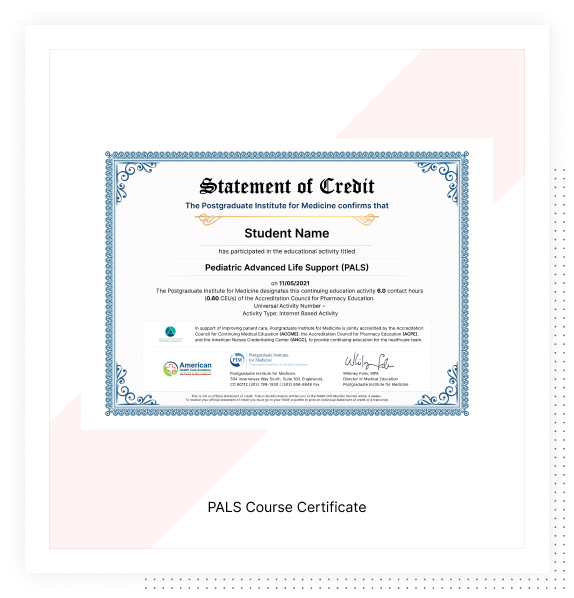
As soon as you pass the recertification exam, your updated digital wallet card and certificate become available for immediate download from your ACLSNow account. Mail and print delivery options are available if you prefer a physical copy, though those take additional processing time to arrive. Because the recertification course is shorter than initial PALS certification and exam attempts are unlimited, most returning providers can complete the entire renewal process, from enrollment to a usable updated card, in a single sitting.
ACLSNow’s PALS recertification course includes continuing education credit that most licensing boards and employers accept toward ongoing CE requirements for pediatric care providers. The exact CE hours awarded are documented on your certificate of completion, which you can submit alongside your PALS wallet card for licensure renewal or employer compliance records. If your state board or professional association has specific CE accreditation standards, confirm that ACLSNow’s CE designation satisfies them before enrolling, since requirements can vary by profession and state.
Most returning providers complete the full PALS recertification course, including all modules and the final exam, in around four to five hours of self-paced study, somewhat faster than initial certification since the material assumes existing clinical background. There is no fixed calendar deadline, so you can spread that time across several days or finish in one sitting, whichever fits your schedule. Unlimited exam attempts mean you are not penalized for taking extra time to review pediatric pharmacology updates before testing.
Yes, you can complete PALS recertification even after your certification has expired, and the course content and exam are the same as they would be if you renewed on time. What changes is your employer’s view of the lapse itself, since some facilities suspend pediatric-unit privileges the moment a required certification expires, regardless of when you eventually renew. Confirm with your credentialing office how they handle a lapsed PALS card before assuming recertification alone resolves any compliance gap. Renewing as soon as possible after expiration is still better than waiting further.


Copyright 2026 © - ACLSNow.com All rights reserved