When it comes to heart health, most people know the basics: eat clean, move your body, and get enough sleep. But the moment you start exploring supplements, it’s easy to get overwhelmed. Fish oil, coenzyme (CoQ10), magnesium, red yeast rice, the list is endless. But do these actually help your heart, or are you just paying for hype?
In a world where nearly 1 in 5 deaths are due to heart disease, according to the World Health Organization, it’s natural to look for something extra to stay safe. But not every bottle on the shelf is backed by science. Some may even do more harm than good. So, how do you know which heart health supplements are worth your time and money? And which ones just have great marketing?
Read on to learn several kinds of heart-healthy supplement options, with evidence supporting and contradicting their use.
What are Heart Health Supplements?
Heart supplements are products made from vitamins, minerals, herbs, amino acids, or plant-based ingredients. They are usually available in the form of capsules, tablets, liquids, or powders. These supplements are not meant to replace meals but to support your diet, especially in areas where nutrients might be lacking.
Some of these supplements may help lower risk factors linked to heart disease, like high blood pressure or cholesterol. For instance, omega-3 fatty acids and certain types of fiber have shown potential benefits. However, not all supplements work the same for everyone. Some may offer little to no benefit, and a few might even be risky if taken without proper guidance.
That’s why it’s important to talk to a doctor before starting any supplement. According to the American Heart Association (AHA) and the American College of Cardiology, more research is still needed before most supplements can be widely recommended for heart health.
Read More: Cardiac Massage – An Overview and Techniques
Top Heart Health Supplements that Work
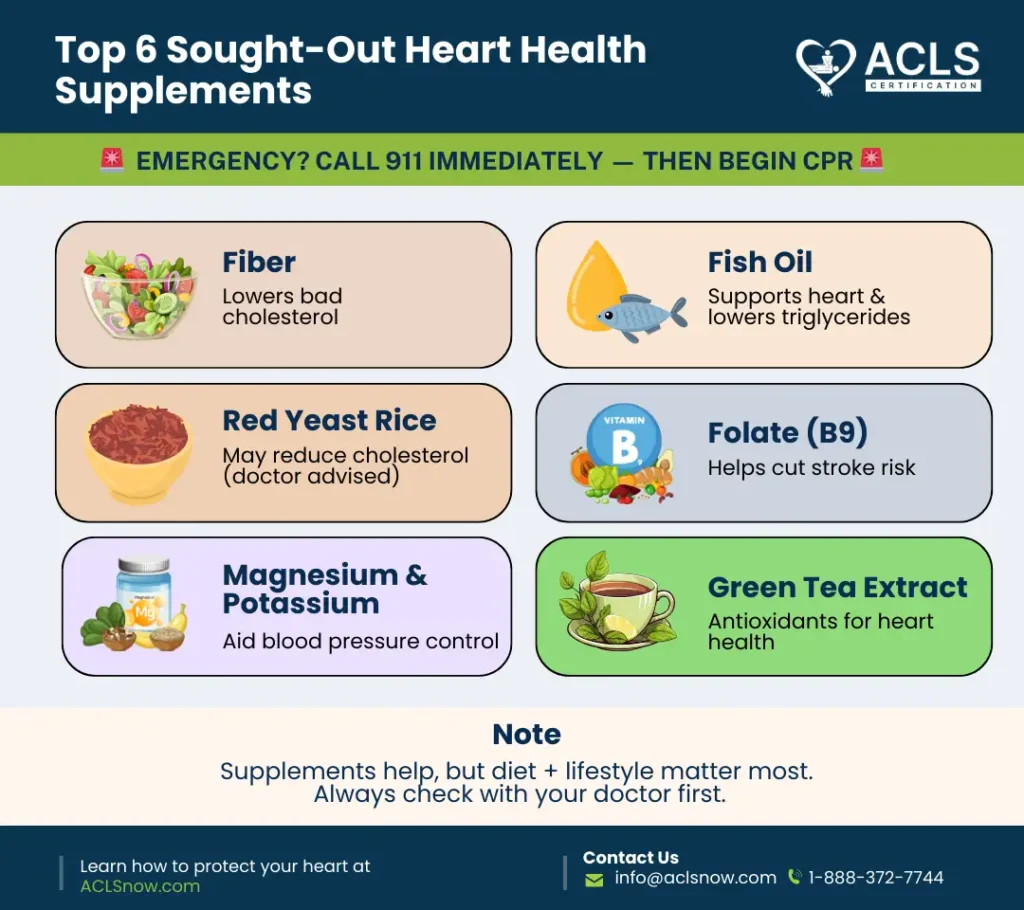
Fiber – Lowers bad cholesterol
Fish Oil – Supports heart & lowers triglycerides
Red Yeast Rice – May reduce cholesterol (doctor advised)
Folate (B9) – Helps cut stroke risk
Magnesium & Potassium – Aid blood pressure control
Green Tea Extract – Antioxidants for heart health
⚠️ Note: Supplements help, but diet + lifestyle matter most. Always check with your doctor first.
👉 Learn how to protect your heart at ACLSnow.com
Experts agree that supplements should not be the first solution for heart health. A balanced diet with whole, minimally processed foods is the best source of essential nutrients. However, if your diet lacks key vitamins or minerals, certain heart health dietary supplements may help fill the gap, such as:
Fiber
Fiber is found in plant-based foods like fruits, vegetables, whole grains, and nuts. Soluble fiber, in particular, can help lower LDL (bad) cholesterol and may reduce inflammation linked to heart disease.
What Research Says:
- Higher fiber intake is associated with a lower risk of heart disease.
- According to a meta-analysis, median doses of ~10.2 g/day psyllium lowered LDL by about 0.33 mmol/L. (American Journal of Clinical Nutrition, 2018)
- When paired with a statin, fiber enhances cholesterol-lowering effects without increasing the medication dose.
Fish oil
Cold-water fish contain fish oil, an omega-3 fatty acid. Eating omega-3-rich fish, such as salmon, tuna, and mackerel, tends to reduce the risk of heart disease. Fish oil capsules are a popular heart health dietary supplement since many individuals do not consume fish on a daily basis.
What Research Says:
- Prescription-level omega-3s significantly lower triglycerides (National Library of Medicine, 2024)
- Moderate intake of 2-3 grams of combined omega-3s (EPA and DHA) may lower blood pressure (Journal of the American Heart Association, 2022).
- Eating fatty fish shows stronger and more consistent cardiovascular benefits compared to supplements, as it reduces risk by ~12%. (Advances in Nutrition, 2022).
Folate (vitamin B9)
Folate, commonly known as folic acid or vitamin B9, is a necessary vitamin. Folate is abundant in green leafy foods like spinach. Similarly, they are abundant in several fortified breakfast cereals.
What Research Says:
- Individuals may be more susceptible to stroke if they have low folate levels and abnormally high homocysteine levels. If necessary, your doctor can do a homocysteine blood test.
- Folate supplementation reduces stroke risk by 10% in people with elevated homocysteine (Journal of Clinical Nutrition, 2024).
Magnesium and Potassium
Potassium and magnesium are popular heart health dietary supplements that may help individuals using blood pressure medication lower their blood pressure.
What Research Says:
- Higher potassium intake lowers blood pressure and reduces stroke risk by 24% (Hypertension, American Heart Association, 2023).
- Caution: magnesium and potassium are not appropriate for everyone. This is because the kidneys regulate these electrolytes. Your kidneys might not be able to digest them normally if you have kidney disease.
Green Tea Extract
Polyphenols are a class of antioxidants found in both black and green tea. The processing of green tea tends to increase its levels of these antioxidants. Compared to black tea, it contains less caffeine.
What Research Says:
- Green tea consumption lowers LDL cholesterol by 4%-8% (Food Science and Nutrition, 2025).
- May reduce the risk of type 2 diabetes and hypertension (Frontiers in Nutrition, 2024).
- Green tea is a heart health supplement that is also associated with a lower risk of coronary artery disease (Cureus, 2023).
Supplements for Heart Health with Minimum Evidence
Some supplements are often marketed for heart health, but research does not strongly support their effectiveness. They are not usually harmful in small doses, but their benefits for the heart remain unclear or minimal. These include:
Coenzyme Q10
Your body produces Coenzyme Q10, sometimes referred to as CoQ10 and ubiquinone, naturally. It is also found in nuts, organ meats, whole grains, and fatty fish. CoQ10 has been found to improve heart failure symptoms. However, research has revealed no clear benefit. CoQ10 was originally believed to help individuals taking statins with muscle pain.
Antioxidants
Numerous plant-based foods include antioxidants. They may help in neutralizing some of the harmful substances in our food and environments that cause cancer, inflammation, and heart disease. However, it is not advised to take large amounts of antioxidant supplements to prevent heart disease. This is due to the lack of solid evidence that antioxidant supplements for heart health can be beneficial.
Daily Multivitamin
You cannot reduce your risk of heart disease by taking multivitamins In most cases, taking a daily multivitamin is not required if you eat a balanced diet. And if you take too many heart vitamins supplements for cardiovascular health, they might be stored in your body, causing more harm than benefit.
Plant Stanols and Sterols
Plant stanols and sterols are naturally found in foods like nuts, seeds, and vegetable oils. When consumed in sufficient amounts, especially through fortified foods or supplements, they can help lower low-density lipoprotein (bad) cholesterol by about 5 to 15 percent.
However, while they are effective at reducing cholesterol, their long-term impact on overall heart health is still being studied. There is no strong evidence showing that they reduce the risk of heart disease or heart attacks. Most experts recommend using them cautiously and focusing on proven lifestyle changes first.
Vitamin D
When you expose your skin to sunshine, your body produces vitamin D. It can also be found in fortified dairy products, seafood, and mushrooms. Individuals with low vitamin D levels may be more susceptible to hypertension, heart attacks, and strokes. Supplements for heart health, however, do not appear to reduce that risk.
There is no proof that supplements enhance heart health, according to a Nature review of 21 trials involving more than 80,000 individuals.
Niacin
Some patients are prescribed niacin to lower their cholesterol. However, it turns out that large dosages of niacin may really be harmful for your heart, even though they might make the results look better.
Other negative effects of taking high dosages of niacin (1,000 mg or more) include flushing and elevated blood sugar. While niacin may still be used in combination with statins for specific cases, it is no longer a first-line treatment for managing cholesterol.
L-arginine
L-arginine is a semi-essential amino acid that helps produce nitric oxide, which supports blood vessel function and circulation. It’s often marketed for heart health due to its potential to lower blood pressure and improve vascular health. However, results are mixed.
While some studies show benefits in people with high cholesterol or mild hypertension, one major trial in heart attack patients found a higher death rate among those taking L-arginine. The study was stopped early for safety reasons. Because of these concerns, L-arginine supplements should be used cautiously, especially in those with heart conditions.
Read more: Heart Blockage – Explained With Pictures!
Choose the Right Supplement To Protect Your Heart!
Heart health supplements can play a supporting role, but they are not a substitute for a healthy lifestyle. Nutrients from whole foods remain the most effective way to protect your heart. Some supplements, like omega-3 fatty acids, have solid research backing their benefits, especially for lowering triglycerides and supporting overall cardiovascular function. Others, such as plant sterols and L-arginine, show mixed or limited results and should be used with caution. Make sure to see a healthcare provider before using any supplements for heart health. They may help you in selecting supplements that might be both safe and beneficial for you.
In cases where supplements or treatments can’t manage serious heart issues, Advanced Cardiovascular Life Support (ACLS) training plays a critical role in saving lives. If you are interested, consider exploring certified ACLS courses to enhance your knowledge and skills in cardiac care.