In October 2023, 18-year-old Dejohn Blunt collapsed from sudden cardiac arrest while playing basketball practice at Winston-Salem Christian School in North Carolina. Two courageous teammates, Simon Koszyca and James Dowie, stepped up to help. They assessed for breathing, began cardiopulmonary resuscitation (CPR), and did chest compressions until paramedics came (NDTV World, 203).
Thus, being a teacher, a nurse, a coach, or a student, BLS training implies you can quickly and assuredly act in such life-threatening cases. Did you also know, however, that BLS certification in the state you are in is not a one-size-fits-all affair? While some necessitate hands-on training, blended or even online training suffices for some. Read on then to understand who must have BLS, what US states accept online certification, and what upcoming modifications it holds for you in your coming year.
Master BLS Now
Get BLS certified with confidence
What Is BLS Certification?
BLS or Basic Life Support training familiarizes you with correct CPR techniques (chest compressions and breaths), use of an AED (automated external defibrillator), and other emergency interventions. It’s for healthcare professionals and caregivers who may need to act for a cardiac arrest. You receive a provider card (which is almost always called a CPR card) after finishing an accepted BLS course, and it is often only valid for a duration of two years. It teaches you adult, child, and infant CPR, AED use, and emergency partnering.
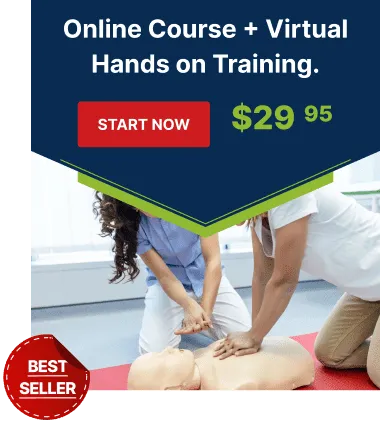
These courses are offered in a fully in-person (classroom), blended (online instruction and in-person practice), or fully online setting. For students who are busy or limited in their access to training facilities, the online BLS course offers a flexible and convenient way of learning lifesaving skills.
Read More: Ultimate BLS Cheat Sheet for Healthcare Workers and Responders
Who Needs a BLS Certification?
BLS certification is primarily intended for healthcare professionals and first responders, but may also be required for others in public safety roles. Typical examples of those who need BLS include:
- Medical Staff: Nurses, doctors, paramedics, EMTs, respiratory therapists, and other hospital or clinic personnel.
- First Responders: Firefighters, police officers, lifeguards, and emergency medical technicians.
- Health Profession Students: Medical, nursing, dental, and allied health students often must obtain BLS as part of their training.
- Other Roles: In some states or workplaces, teachers, coaches, child care staff, or school nurses may be required to be BLS-certified (for instance, K-12 teachers or school sports coaches under certain laws).
Do States Accept Online-Only BLS Certification?
Most employers and state boards accept online and blended CPR courses, which combine online learning with a brief, in-person skills session. While many 100% online classes are widely accepted, BLS certification requirements by state may vary..
- California’s Dental Board explicitly states that BLS courses “must include a live, in-person skills practice session, a skills test and a written exam”.
- Virginia’s teacher-licensing rules say CPR training must include hands-on practice.
- A few jurisdictions have relaxed rules. Texas allows online training if a supervised skills check is included.
- States like Alabama, Georgia, and Kentucky may also allow fully online courses. However, these exceptions are rare.
Always verify your state’s or board’s rules before starting your BLS course..
Now that we know which states accept online-only BLS certification, let us see which states require BLS certification and some state-specific requirements.
What Are the BLS Certification Requirements by State?
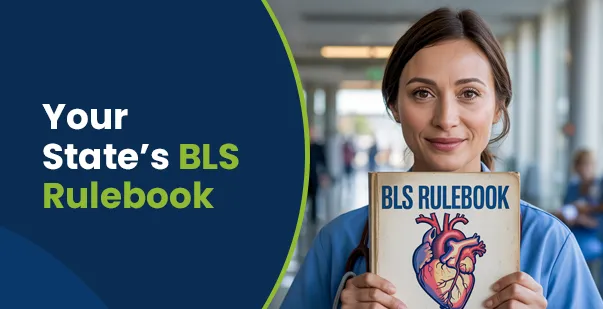
All 50 states accept a valid BLS course completion card if it is nationally accepted. By default, an AHA BLS card (mostly valid for 2 years) meets the CPR requirement everywhere in the U.S. However, state laws can add specific requirements or accept alternate courses.
The table below highlights a few examples of BLS certification requirements by state in 2025.
| State | Online BLS Allowed? | Special Notes & Mandates |
| California | No (It must include live skills) | California law requires CPR training for high school students. |
| Florida | Yes, but it should include hands-on experience. | The Florida Board of Nursing specifies that renewal requires a course with a practical skills test, even if the coursework was completed online. |
| Texas | Yes, along with a skills check. | State Ed Code requires band directors & head coaches to maintain CPR/First Aid.
Teachers are not required to hold CPR, though districts may require it. |
| Michigan | No, as hands-on training is required. | First-year teachers must complete CPR/FA with mannequin practice. |
| New Jersey | Online training is not accepted | NJ rules for coaches (NJSIAA) specify that all high-school coaches must hold a current CPR, AED and Basic First Aid card, and online-only CPR courses are not accepted. |
| Illinois | Yes, with skills check. | Illinois’ 2024 law requires all schools to implement a “cardiac emergency response plan” by January 2025. |
| Colorado | It is accepted if it is recent. | |
| Arizona | Yes, online training is valid. | Arizona’s athletic coaching certification (grades 7–12) requires valid First Aid and CPR certification. It accepts online courses for coaches. |
What Are the Key State Rules and Updates for 2025?
As BLS certification becomes more standardized across the U.S., individual states continue to introduce new rules to meet evolving safety and healthcare needs. From school staff and healthcare providers to high school students, many groups are now required to complete CPR and BLS training. The key BLS certification state guidelines and updates to watch for in 2025 are:
-
School Coaches and Staff
Recent updates to BLS certification state guidelines have placed more emphasis on school safety. In Florida, a 2024 law (effective July 2024) mandates that all public-school athletic coaches hold current CPR, First Aid, and AED certification, to be renewed biennially.
-
Healthcare Providers
The BLS requirements for healthcare providers require medical workers to maintain current BLS certification through nationally accepted providers. The State Education Department of New York requires nurses and physicians to hold BLS certification as part of their continuing education (CE). Proposed legislation in 2025 may add requirements for electronic card verification and standardized provider listings.
-
Graduation CPR Laws
Across the US, it’s now common for states to require student CPR training. According to the BLS certification rules by state, 38 states (plus DC) require hands-on CPR instruction for high school graduation. While not a certification card, this means most graduating teens will have formal CPR training by 2025.
-
Certification Standards
Regulatory boards are clarifying approved course content. For instance, California’s Dental Board explicitly mandates live skill practice in BLS courses. Many state boards publish approved provider lists or course requirements; be sure to review those, as they can change each legislative session.
-
National Credibility
No matter the state, all BLS certifications must follow national ECC (Emergency Cardiovascular Care) guidelines. Any new state won’t reject your existing valid card outright. However, on renewal or in a new job, you may have to meet local stipulations (e.g., hands-on skills, specific instructors). The updates above mostly affect new hires and training policies rather than invalidating prior certifications.
How Can You Choose the Right BLS Course?
With various formats and providers available, it’s important to select a course that fits both your schedule and your BLS certification requirements in your state by 2025. The best way to find the right course is:
1. Pick a Recognized BLS Provider from Trusted Organizations
Choose a BLS course from a well-known provider accepted nationwide. Look for training from trusted names or state-approved partners to make sure your certification is valid and accepted by employers and licensing boards everywhere.
2. Choose a BLS Course According to Your State Requirements
Blended BLS courses allow you to complete the theory online and finish with a short in-person skills session. Most employers and state boards widely accept this format. While fully online courses may be convenient and are accepted by some states, always check with your employer and state board before opting for one.
3. Make Sure the Course Includes a Skills Test
Your BLS training must include a live skills test with an instructor. This hands-on practice helps you learn CPR and emergency skills the right way and makes sure your certification will be accepted where needed.
4. Renew Your BLS Certification Before It Expires
BLS cards are only valid for two years. Set reminders and plan ahead so you can renew your certification on time. Waiting too long may cause problems at work or with your professional license.
Read More: A Simple Guide to Becoming a BLS Instructor
What Happens to Your BLS Card if You Move to Another State?
BLS certification is nationally recognized, so your valid card moves with you. There is no state registry, and thus, any state or hospital will generally honor a BLS card from another state. In practice, this means you can take a BLS class in California and use the same card in Florida, New York, etc. However, there are two conditions: first, if your new state or employer has extra requirements (e.g. specific hands-on component, instructor credentials, or a particular provider), you may need to meet those when you renew or get a new job.
Second, always carry your physical or digital BLS card and a transcript of completion when you change jobs or licenses, as you may need to submit proof. Generally, though, moving states does not invalidate your certification. When your card is near expiration, renew through any accepted provider, but you may choose one that fits the local preference.
Read More: BLS Certification for Physical Therapy
Get BLS Certified and Stay Prepared for Emergencies!
Being BLS certified means you are ready to help in emergencies. BLS certification requirements by state vary based on rules about what kind of BLS training is accepted, especially when it comes to online or hands-on courses. But one thing is certain: having an active, current BLS certification is a must. With 2025 comes new updates to state laws and training standards; now is as good a time as any to verify your certification status. Don’t wait too long.
Take action today, choose a trusted BLS training provider, and get certified. You’ll gain skills that matter, confidence in emergencies, and peace of mind knowing you’re prepared to help when it counts most.