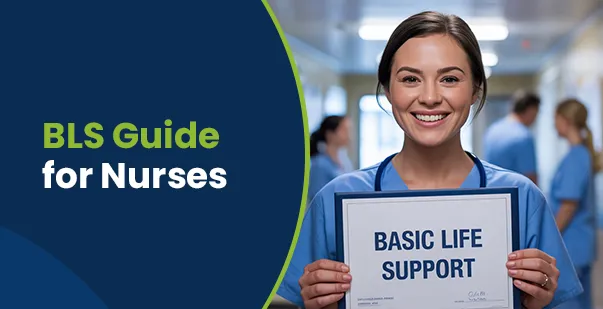
What would you do as a professional nurse if a patient’s heartbeat or breathing stopped suddenly? If you know the right techniques, you can save a precious life immediately, but if you don’t, it’s high time to reconsider your training. As a registered nurse (RN) or licensed practical nurse (LPN), you must know all the life-saving skills to help patients in distress. This is where the basic life-saving (BLS) certification for nurses comes in.
The U.S. Bureau of Labor Statistics states that the employment of registered nurses is already projected to grow by 6% in 2033. Hence, all nurses must remain competitive, competent, and prepared with the best training.
The BLS certification for nurses is one such training that is also mandatory for healthcare professionals in many hospitals and clinics. If you are a new nursing graduate or an experienced nurse looking for ways to upskill yourself, this nursing BLS certification guide is for you.
Master BLS Now
Get BLS certified with confidence
What Is BLS Certification?
BLS is a course that trains individuals to recognize and respond to life-threatening emergencies like cardiac arrest and respiratory failure. It includes high-quality cardiopulmonary resuscitation (CPR), automated external defibrillator (AED) use, and relief of choking in adults, children, and infants.
Unlike general first-aid courses, BLS is for healthcare professionals who may be the first responders in a medical emergency. It aligns with the guidelines of recognized organizations and must be renewed every two years to stay current with changing standards.
BLS certification is required for RNs, LPNs, Emergency Medical Technicians (EMTs), medical assistants, and other direct patient care staff. In most healthcare settings, the certificate is considered a pre-employment prerequisite.
Read More: The Ultimate BLS Cheatsheet (+Infographics)
Why Is BLS Required for Nurses?
Nurses are often the first to respond when a patient’s condition suddenly worsens—whether it’s a cardiac arrest in the ICU, a respiratory emergency on the general ward, or a collapsed visitor in the hospital lobby. Basic Life Support (BLS) certification equips nurses with the skills to handle these critical moments immediately, before a full code team arrives. Here are some additional reasons why BLS training for RN and LPN nurses is a must in today’s world:
Life-Saving Skills for Every Unit
Nurses, regardless of specialty, may encounter cardiac emergencies. Having a BLS certification for nurses ensures a rapid, competent response in emergencies, irrespective of whether they are working in pediatrics, geriatrics, surgery, or maternity. BLS techniques can stabilize a situation until advanced medical help arrives, from a choking infant in a pediatric ward to a collapsed patient in a waiting room.
Legal and Institutional Requirements
Most state nursing boards, including the National Council of State Boards of Nursing (NCSBN), either directly require or expect active BLS certification for license renewal or employment in clinical settings. Healthcare employers also enforce this strictly. Hospitals, nursing homes, and outpatient surgical centers often will not hire or retain nurses without a valid BLS certification. Many use it as part of the initial onboarding and annual competency checks.
Mandatory for Specialized Nursing Roles
Advanced certifications like Advanced Cardiac Life Support (ACLS for adult care), Pediatric Advanced Life Support (PALS for pediatric care), or Neonatal Resuscitation Program (NRP) all build on BLS skills. Nurses in certain specialty roles are typically required to hold current BLS certification, which includes emergency and trauma, Intensive care Units (ICU, CCU), labor and delivery, oncology and post-operative recovery, home healthcare, and school nursing, etc.
BLS Enhances Interdisciplinary Teamwork
In code blue scenarios, nurses don’t just follow orders. They often lead the initial response. With BLS training, nurses can communicate effectively using standardized language (e.g., CAB: Compressions-Airway-Breathing). They work in sync with physicians, respiratory therapists, and EMTs. They help assign roles and maintain calm under pressure
What’s Included in BLS Certification Training For Nurses?
The BLS requirement for registered nurses varies across the United States. However, several important aspects of saving a life in an emergency are included in the curriculum of the training course, which include:
CPR Techniques
You will learn high-quality CPR for adults, children, and infants using correct hand placement, compression depth, and rescue breaths. Hands-on practice and real-time feedback are part of every accredited course.
AED Training
Nurses are trained to operate an AED, a device that delivers a controlled shock to the heart during sudden cardiac arrest. You’ll learn proper pad placement and when to administer shocks as a part of the AED program management curriculum.
Team-Based Resuscitation
Modern BLS courses emphasize team dynamics, especially in clinical settings where multiple responders are involved. Communication, role assignment, and coordination are also covered.
Choking Relief
Instruction includes how to assist choking individuals using the Heimlich maneuver or back slaps and chest thrusts in infants. This helps nurses provide instant relief to patients who may have experienced choking emergencies.
Read More: RQI vs. Conventional BLS Training
How to Get Certified in BLS
You will find several platforms that provide a BLS certification to nurses, medical professionals, and other individuals. However, you must also be aware of the steps to get certified to avoid making any mistakes at the last moment. These include:
Choose an Accredited Provider
Search for the most widely accepted BLS certification providers in the United States. Please note that many hospitals only accept BLS cards issued by accredited institutions.
Pick a Learning Format
You can choose between classroom-based courses with instructors and hands-on practice or blended learning, which combines online theory with in-person skills testing. You can also enroll in a fully online course where you learn topics through AR/VR for real-world simulations. Most of these courses are accepted by employers. However, you should always check with your HR first.
Pass the Written and Skills Exam
To earn your nursing BLS certification, you must score at least the minimum marks required on the written test. This also involves showcasing your CPR, AED, and choking relief techniques on manikins to your potential employers.
Receive Your BLS Certification Card
You will receive a BLS Provider Card, typically valid for two years after passing the exam. Keep a copy for your records and renew before it expires. This will allow you to showcase your talent and skills to potential or existing employers.
How Long Is BLS Certification Valid?
Your BLS certification is usually valid for two years from the date of issue. Once expired, you are no longer considered BLS-certified, which could impact your job status. Many institutions send reminders in advance to renew. It’s a good idea to set a personal reminder a month before your card expires.
The good part is that BLS renewal is often faster than initial certification. Many providers offer renewal courses that focus on updates to guidelines and skills refreshers. These usually take 2 to 3 hours and include an updated written exam and skills test.
What Are the Tips for Passing the BLS Course?
Most nurses must master rapid response under pressure. BLS is the foundation for ACLS courses, which are often required for RNs and LPNs. These are among the top certifications that also promote a safer work environment. On that note, here are the tips you can follow to pass the BLS course successfully on the first attempt:
Practice Hands-On CPR
Hands-on CPR is one of the primary techniques to save victims in cardiac, respiratory, or choking emergencies. Use practice kits or attend additional skill labs to improve your comfort with chest compressions and rescue breaths. This will help you attend to patients in emergencies until a senior medical professional arrives at the scene.
Understand the Sequence
Memorize the Compressions-Airway-Breathing (CAB) sequence, adult AED usage, and choking relief steps. Several training providers also allow you to practice these sessions with manikins, which makes it easier for you to understand them.
Stay Calm During the Test
Both the written and practical exams for BLS certification are straightforward if you have paid attention during training. Breathe deeply and focus on the rhythm and accuracy. Make sure you stay calm during the test to avoid any mistakes.
Don’t Wait Until It Expires
You can renew your BLS certificate up to 6 months before your expiration date. Letting your certification lapse may require you to take the full course again. So, make sure you renew it before the expiry date.
Know What’s New
The American Heart Association (AHA) regularly updates CPR guidelines. Renewal courses highlight changes, such as updated compression-to-ventilation ratios with an emphasis on early defibrillation and minimal interruptions. Make sure to track all these changes regarding the guidelines annually.
Upskill Yourself with a BLS Certification for Nurses
BLS certification for nurses is about meeting a job requirement and being ready to save a life at a moment’s notice. Sometimes, you may be required to respond to a code blue in a hospital or help a choking stranger in a restaurant. Hence, having BLS skills allows you to help victims more promptly in these critical moments.
With so many accessible training options, regular updates, and employer support, there’s no excuse not to stay certified. Make sure that your current certification is up to date, your skills are sharp, and your confidence is high. If you have yet to equip yourself with these life-saving skills, enroll in a certification course now.